Uncategorized

Calls not to “politicise” the assassination of an MP are weasel words by the architects of hate

A lot of things that have happened in the last couple of years have made me uncomfortable. One of the less important ones is the growing fashion for writing gushing obituaries on social media about dead celebrities. Like so much that one criticises, I’ll probably find I’ve done it myself at some point but it still doesn’t seem particularly healthy. We first started treating grief as a public recreational activity when Princess Diana died and we’ve never really stopped.

 I didn’t know Jo Cox and, although I’d heard the name, even as a member of the Labour Party I couldn’t have told you before yesterday which constituency she represented or which particular issues she was known for championing. And yet, unlike anyone else in the pantheon of 2016’s dead celebrities that I had never met, her death got to me. For the rest of the day after I heard the news, I felt distracted and agitated by it and I found myself welling up as I heard some of the reports.

By explaining why this was so and by expressing the emotions I felt at hearing the news, I will be accused of “politicising” a political assassination by a desperate but powerful rear-guard action on the right-wing of British politics. On social media and in the tabloid press they are spinning their vile rhetoric anew, seeking to minimise the capacity of this horrific crime to shine a light on the hatred and fear they’ve been whipping up in our society over weeks, months and years. Typically, a political assassination is politicised by the assassin, not the outraged supporters of the target. The weasel words of the apologists who try to defend the indefensible make me sick to my stomach.

When I was 12, my father died with no warning whatsoever. It’s not what people often imagine if they’ve never experienced the sudden loss of someone close to them; the anguish and torment that people often assume would be the logical response comes later and more slowly. Sudden death leaves a gnawing, burning sensation that never really goes away rather than delivering an immediate sucker punch. The first few days are all numb disbelief. All the more remarkable, then, that Jo Cox’s husband Brendan was able to issue such a coherent response within just a couple of hours of his wife’s cold-blooded murder:

“Today is the beginning of a new chapter in our lives. More difficult, more painful, less joyful, less full of love. I and Jo’s friends and family are going to work every moment of our lives to love and nurture our kids and to fight against the hate that killed Jo.

Jo believed in a better world and she fought for it every day of her life with an energy, and a zest for life that would exhaust most people.

She would have wanted two things above all else to happen now, one that our precious children are bathed in love and two, that we all unite to fight against the hatred that killed her. Hate doesn’t have a creed, race or religion, it is poisonous.”


Hate was the catalyst. We should be deeply suspicious of those who would prevent us from naming it and finding its source, or cry “mental health” as a smokescreen (as though they’ve ever given a toss about mental health before)- gun control campaigners in America know all too much about that sordid deflection tactic. Three separate witnesses report that the alleged killer (I won’t name him) shouted either “Britain First” or “Put Britain First” as he killed her (update 18/06/16: the defendant has appeared in court and given his name as “death to traitors, freedom for Britain.”) There has been a clamour by the far right (especially the group actually called “Britain First”) to try either to deny his links to right-wing politics altogether or to obfuscate about it. This is pathetic. These are the very people who routinely criticise moderate Muslims for failing to condemn Islamic terror loudly enough. It would be the easiest thing in the world for these people to say something along the lines of: “if, as the evidence appears to be suggesting, this individual was acting out of a twisted interpretation of British nationalism, then we wish to emphasise that he does not act in our name and we condemn it utterly.” Instead they attack the “left” (read: everyone that thinks things are going too far when MPs get gunned down in the street in broad daylight) for “politicising” murder, blaming the witness reports on “mainstream media lies” and even, in some cases, suggesting the murder itself was a “false flag” operation by secret agents working for the EU! These are the lengths people on the right of our politics will go to in order to shirk the responsibility for what is happening in our country.

And what exactly is happening? Let’s assume, as I desperately hope we can, that this is an isolated incident; merely the most extreme element in the pervasive web of fear and hatred being spun throughout this country. Why now? What has happened to ratchet such sentiments up so high? Yesterday Nigel Farage unveiled an advertisement which looked as though it had been directly photocopied from a snippet of propaganda used by a group of people in the 1930s I daren’t mention for fear of invoking Godwin’s Law. This was only the latest act in a deliberate and orchestrated campaign to whip up hatred against immigrants and foreigners by a group of people who wish to persuade us to leave the European Union: to “take back control”, to “make Britain great again”, to stick it to Johnny Foreigner and put Britain, well, first. In an atmosphere of ignorant tabloid rage, whipped up by poisonous demagogues like Michael Gove and Boris Johnson, an already hysterical referendum campaign is becoming a battle for the survival of some of this country’s most basic values or, as Martin Kettle  argues in today’s Guardian, a battle between the press and democracy itself.

It’s not just those on the “Remain” side of the EU debate who believe things have gone too far. Even in the pro-Brexit Spectator yesterday, in a piece for which author and publication alike should be greatly commended, Alex Massie observed: “if you shout ‘breaking point’ over and over again, you don’t get to be surprised when someone breaks.” Those who are deliberately and knowingly encouraging aggression and antipathy towards entire groups and communities to suit their own political aims now have the gall to turn round and accuse everyone else of “politicising murder.”

Jo Cox’s alleged killer did not represent the campaign to leave the EU but it is becoming increasingly clear that he was a symptom of the same hate it’s been peddling. This hideous referendum has unleashed a wave of xenophobic bile we must fight with all our might. Jo Cox believed that and paid for it with her life. She wasn’t just another celebrity whose death can be dismissed with the usual barrage of safe platitudes and uncontroversial praise through amateur Facebook obituaries. She was assassinated for her beliefs and if pointing that out is politicising her death, then so be it: let’s politicise, as loudly and as unashamedly as we can. Politicise it until it can’t be politicised anymore: for democracy, for Ms Cox and her family and for the dream of a better world that was her life’s work.


Inside Finland’s Miracle

This week I had the privilege of travelling to Finland to find out what makes their world-beating education system tick- and what the UK could learn from their achievements.

As Finland slides into view, Paavo Piik, an Estonian theatre director I’m working with, smiles and gestures towards the coastline. “There it is,” he says, “the promised land!” To teachers all over the world, Finland has become a byword for getting it right in education. I’m exhausted after two back-to-back early mornings but that doesn’t dampen my excitement as our ferry approaches the end of its two-hour crossing from Tallinn and Helsinki takes shape in front of us. I’m halfway through my final term as deputy head at an inner London primary school and since I started teaching in the British system twelve years ago, and throughout all the frustrations that has involved, I’ve always wanted to come and see this for myself.

ferry1

I’m here in my half-term at the invitation of the Theatre of Europe. We’re creating a show exploring the challenges facing educators, particularly in the UK, through an international lens. My companions are all Estonians: Paavo is a director, Paul is a producer and Arun is a filmmaker, here today to document our visit. We’re visiting two schools in very different settings before meeting Krista Kiuru, the former Finnish education minister. One of our aims is to learn the secret of their success: how do they achieve such apparently high standards (Finland consistently outperforms the UK in the PISA international rankings) while ignoring almost all the instruments a succession of British governments has insisted on using to achieve the same goal? In Finland there is no statutory testing until children are sixteen, they have no formal inspectorate and teachers have the freedom to teach as they see fit with almost no interference from government. The pressures and anxieties that are causing an unprecedented number of British teachers to leave the profession simply don’t exist here. These facts also make us keen to play devil’s advocate as we explore this apparent Nirvana first-hand: what’s the catch? Surely nothing in life is this simple.

Our first stop is Siltamäki, a small town just outside Helsinki. The first people we see are a kindergarten class sitting outside singing with their teacher. Estonian is pretty similar to Finnish and Paavo is able to inform me that the song (sung to the tune of “The Wheels on the Bus”) is about a duck who goes “quack quack quack.” Straightaway it looks like a British education minister’s nightmare: a group of children doing something “fun” and “woolly” rather than “rigorous.” I can almost hear the them scoffing in my head. The children sit close together but in whatever position makes them comfortable, facing whichever direction they please. Everyone looks remarkably relaxed.

The principal meets us at the door and I’m amused by her demeanour, which is considerably more familiar to me and is probably the same all over the world: formidable, energetic and intensely proud of her school. She doesn’t really care who we are: there’s a film crew in her school and she’s determined to show off its achievements. They’ve been working on a musical production, and she shows us some of the children’s artwork it has inspired. In everything she says, she keeps coming back to the musical which seems to have been the focus of the school’s work for weeks if not months.

principal2.jpg

“I pity the children who don’t like musicals!” Paul says as we’re led into the hall to watch a snippet of the production itself which is being rehearsed. Every child in the school has made a contribution and everyone is involved in its performance and execution. Standards (meaning actual standards, not test results as that word has come to mean in the British system) are extremely high. Without a national assessment agenda, there is far more room for children to follow their interests and that is true in this performance: some of the children are hunched over a laptop controlling the videos they’ve filmed and edited with remarkably high production values, others are on the stage in beautifully-crafted phoenix costumes performing a dance while about twenty others form an extremely impressive band including singers, percussionists and a variety of instrumentalists including a tiny boy with a bass guitar who is cooler than any British person will ever be. The only children in the hall are those needed for this particular section of the performance and all of them are involved- no one is sitting around waiting for “their bit.”

“This is all very nice,” the acid tone of the Tory minister I’m carrying around in my head says, “but children need to learn basic skills. Where is the rigour?” I finally sit down with one of the children, a sixth-grade girl who is twelve years old and one of the few ethnic minorities in the school. I’ve just seen her singing beautifully in the show but once again the Tory minister in my head pipes up: “we as a nation can’t compete in the global race by singing.” so I ask her what her favourite subject is.

“Maths,” she replies immediately, “it’s really fun and you have to think in lots of different ways.”

I smile and complement her English (plenty of English twelve-year-olds can’t speak English as confidently.) Some children must find that difficult, I say. Of course, she replies, and the teacher spends extra time helping those children. The same is true in all the subjects they study. They spend plenty of time studying what we in the UK would call “core subjects”; they just don’t get themselves wound up about it by assessing them obsessively and crowding everything else out of the curriculum.

Jamelia2.jpg

Next we head upstairs and visit a lesson. The children are about eight or nine; each of them is at a computer and each of them is just playing Minecraft. The spluttering, red-faced rage of the minister in my head is not even comprehensible now. The class teacher, a long-haired, tattooed guy in a t-shirt who would look more at home at a metal concert than in a primary school classroom, explains what they’re doing. Each student is helping to design and maintain a city. They each have a different role in overseeing the effective administration of the virtual city and all of them have unique problems to solve, all of which are controlled and monitored at the teacher’s terminal. We ask the teacher what subject the children are doing and he shrugs. It’s not something he really worries about. They’re learning about the world they’re going to have to live in and the problems they might have to help solve when they’re older. He tells us he loves Sid Meier’s “Civilization” computer games and I nod enthusiastically. I’ve often said those games taught me more as a teenager than any subject I learnt at school.

minecraft1.png

This free-flow approach to the curriculum is the next step in Finland’s evolution as the school’s vice-principal explains to us when we emerge from the class. I’d read about this in the UK news a week or so before our visit but she is able to explain it with a clarity the British media always seems to lack when reporting education stories. Of course there is a compulsory framework, she tells us, but it’s a basic outline and the rest is about the teacher’s creativity and the interests of the students. I ask how this curriculum is to be enforced. How does the government know that the basic offer (such as essential maths and Finnish language content) is being delivered? We’re told that schools are required to publish their own curricula on their websites (ha! You DO have to do something we have to do!) which is shared with parents and must be agreed with the education department. And that’s it. That’s Finland’s accountability system.

We thank the staff and we’re left with considerable food for thought as we drive away. What we’ve seen was wonderful but could it work with the levels of inequality we have in England? Or in the multicultural communities that inner London schools now serve? That’s what we’re going to find out. Our next destination is Aurinkolahti, a multi-cultural primary and secondary through-school in inner-city Helsinki. There is a new challenge here. Only 5% of Finland’s population was born overseas, even that figure is a considerable increase compared to a decade ago and the country’s ethnic minorities are heavily concentrated in this part of its capital.

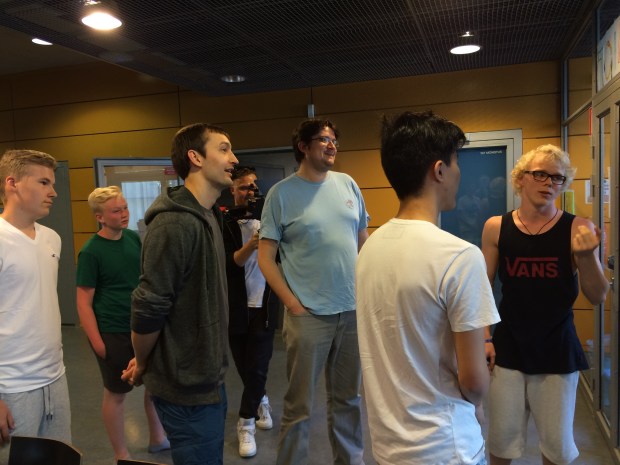
Again we’re met by the principal but this time she immediately delegates the job of showing us round to a group of students. These are teenagers who’ve recently done something for the very first time: national tests. It’s the last week of term (I’m told Finnish schools have seven more weeks of holiday than we do in the summer, as well as shorter days and more breaks- well of course they do) and many of the younger children are on trips. This visit is an opportunity to see the results of Finland’s education system: its sixteen year-olds who are the “Finnished product.” (sorry)
tour1.jpg

Over the hour that follows my mind is completely blown. Throughout the school there are dozens of sixteen-year-olds, from a wide range of social and ethnic groups, doing quite literally whatever they want. Some of them are lounging around on bean bags chatting or reading, some are playing sport in the gym and the majority are engaged in their own business using the school’s generous resources: there are students in the best-equipped design and technology workshop I’ve ever seen working on their own projects with a range of tools and machinery, there is another group in a maths classroom working out how to program a robot to walk and dance, there is a group of girls in the art studio producing beautiful portraits and another group gathered around a stage making props and costumes for a performance.

No one is running, no one is shouting and there is no sign of any tension or argument. Wherever we go, we meet young people enthusiastically wanting to show us what they’ve been doing. They recently went on a school trip to London and they play us a video they’ve produced of the trip. In temperament, they’re as sweet and polite as the most pleasant primary school classes I’ve taught. In intellect, they just seem like well-rounded adults.

This is the last week of term and it isn’t typical. Before their exams, their timetable varied between three and six hours of classroom learning a day and they attended subject lessons like anyone else. The difference is that the exam syllabus was only one part of what was valued in those lessons. I ask how their exams went and, with a shrug, they say they were fine. Paavo asks whether the exams are important. They tell us they can be and that universities “take an interest” in the results. Some of them are planning to go to university and some of them aren’t. Those that aren’t tend to have very specific plans for the technical courses they intend to go on to based on the skills they’ve had the opportunity to develop at school.

Life isn’t perfect, they tell us, and of course adolescence isn’t easy anywhere but, the more I speak to these remarkable young people, the more I realise the concept of the “teenager” isn’t inevitable. The stroppy, rebellious, antisocial youths prone to cruelty and excessive risk-taking we see all too often in most English-speaking societies aren’t inevitable: we have created them. Their behaviour is a choice we have made and continue to make. As I’m led around this school, I’m torn in two by two equally powerful but competing emotions. I’m utterly inspired by the sight of what’s possible when young people are nurtured and empowered rather than patronised and scrutinised but I’m also furious with my own compatriots, realising how stupid and primitive we Brits really are when it comes to one of our most important responsibilities: the education of our young. I feel like a time-traveler visiting the future from an earlier and more savage age.

Next we interview two teachers; one teaches maths to the older students and the other teaches English and German. We’re astonished that they’re happy for this to take place with an audience of about twelve of their students. This is a testament to the relationships between teachers and students here: they are friendly, informal and authentic. There are no uniforms for the students, teachers wear whatever makes them comfortable and everyone calls everyone else by their first name. The teachers talk completely candidly about their job including its challenges (even Finnish teachers have some paperwork- there’s still no way round the need for safeguarding procedures, for example) and the changes on the horizon in terms of the creative, topic-based curriculum. They love their job and, while they still feel pressure, I can’t help feeling that it’s the right pressure: to make learning inspiring for their students and to ensure they’re motivated to be the best they can be, not just to be good at exams but to be thoughtful, focused, friendly and skillful in a range of disciplines.

class1

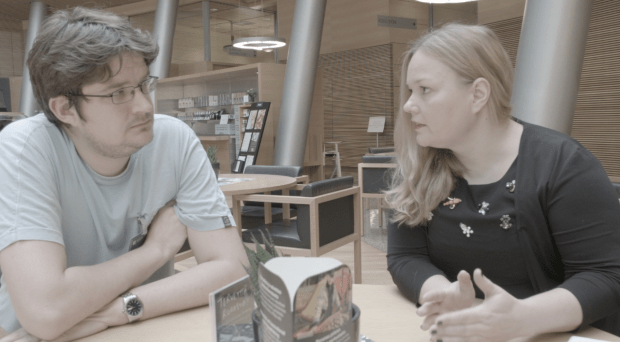
Somewhat stunned by what we’ve just experienced, we get back in the car and, after a brief stop for lunch, we’re off to the Finnish parliament building for our final appointment: a meeting with Krista Kiuru, the former education minister and one of the architects of its current evolution. We sit around a table in the café and reflect on what we’ve seen during the day. I’ve met quite a few politicians and she has the same studied charisma and careful presentation that I’ve observed in all of them but there’s an authenticity and warmth about her that her British counterparts often lack. There’s also genuine and unmistakable passion as she warms to the theme of Finland’s education system. What’s amazing is the lack of complacency; she doesn’t want to talk about Finland’s achievements but about what it needs to do to be even better.

Scoring well in the PISA rankings was never Finland’s primary objective- its aim was to create a better life for its young people and its performance in the international tables was just a welcome bonus (which makes the remarks of Gove, Morgan and Cameron about Britain’s drive to climb those same rankings look even more absurd) but, having achieved what they did, they were then a little spooked when they dropped slightly between 2012 and 2015. Yet Krista’s response to that drop is to insist the Finland needs to go even further down the road it is already taking: to put even more emphasis on student motivation, engagement and well-being.
Krista2

Finland is still haunted by two US-style mass shootings in quick succession in 2007 and 2008 in which a total of 20 students at a high school and a technical college respectively lost their lives. This has made it easier to argue for an system that puts student’s happiness at its centre and what is most remarkable about Finland’s education agenda is that it enjoys complete cross-party support. Krista’s Social Democratic Party is out of power now and the government is dominated by the centre-right. While this brings frustrations (for example, Krista believes the new administration is failing to provide sufficient funding to schools with additional challenges presented by immigration and inequality like Aurinkolahti) the basic direction of travel has the agreement of everyone in the Finnish parliament. Rather than becoming the political football education represents in the UK, Finland’s school system has adopted a consistent direction of travel, agreed in collaboration with teachers, to which the entire country has seemingly signed up. Paavo asks if Krista is certain that the new reforms can make standards even higher and simultaneously make the education process even happier and more inspiring. Her answer is simple: “it must.”

I want to talk to Krista about the challenges we would face in exporting the Finnish model to the UK. I tell her that our Tory government have always insisted we must learn from the best international examples and I ask her if she ever had any contact from British ministers asking for her advice when she was education minister. She just laughs, shakes her head and looks at me with what I can only call pity. As well as education minister, Krista has also been Finland’s housing minister; she talks briefly talks about how Finland has striven to ensure socially mixed communities and how important this has been to the smooth functioning of their education system. I want to talk about this further, especially as housing is something we’re making even more of a mess of in the UK than education, but we’re out of time. Paul has already gone to get the car and he texts to tell us we need to leave or we’ll miss our ferry. Our seven hours in Finland have absolutely flown by.

boat.jpg

Minutes later, we’re sitting quietly aboard the ferry, individually reflecting on everything we’ve seen and heard. I walk up the deck and watch Finland recede into the distance. So much of what I’ve witnessed has only been possible because of Finland’s unique circumstances. It has an adult population that values education more than the majority of British adults do, it is a far more economically equal country than the UK and it has a parliamentary system that encourages gradual evolution rather than dramatic ideological swings. Yet there is so much I’ve seen that we could start doing tomorrow in the UK if only there was the political will.

In the UK we’re failing our young people. We’re clobbering them with an enormous, prescriptive barrage of exam content and building our entire system around that content, rather than the students themselves. It isn’t going to change tomorrow and it isn’t going to change next year. But, turning my back on a remarkable country and facing into the powerful breeze from the open sea, I try and find a reason for a little optimism. No one knows what the future holds, even our politicians. That imagined government minister whose voice was rattling around my head earlier suddenly seems so utterly small and pathetic. Our government have no answers to the big questions about education in the 21st century and they get laughed at by the people who do. I decide there is only one conclusion I can allow myself to draw from today: the promised land is out there, I’ve seen it with my own eyes and maybe one day we’ll get there too.

7 Principles for a Better Primary School Accountability Framework

The politicians currently dictating what happens in our schools have got it into their heads that they can raise standards just by making statutory tests harder. There is no evidence for this. They say we need to improve our position in global comparison tables such as those produced by PISA or the OECD. This would probably be a good thing to do: if our 18-year-olds were as good at passing tests as 18-year-olds in Finland, it would mean we were getting something right, even if it wasn’t the whole story. But even if you believe that improving our global ranking should be the sole aim of education policy in this country, then we are still going about it in completely the wrong way, and in completely the opposite direction to a country like Finland.

I’m a big believer that if you’re going to point out a problem, you will be able to do so far more convincingly if you can simultaneously offer a solution. With that in mind, here are seven principles that any government, party or campaign might want to think about when considering what an alternative approach to accountability in primary schools might look like.

  1. Tests should be used to set minimum expectations rather than define high standards.

The recent chaos around primary assessment is causing something of an over-reaction in some quarters, with some teachers and parents taking to social media to demand an end to any sort of testing whatsoever in primary schools. I don’t mind the occasional maths and English test, so long as it’s well-designed, relevant to a clearly-specified curriculum and used primarily as a tool for teachers and head teachers to inform their plans.

 It seems to me that testing is most useful if it is kept relatively straightforward; as one of several effective tools to identify those who are struggling to master the basics so support can be put in place. For the majority of children, such tests should be something to celebrate; an opportunity to show what they know and a benchmark on which the rest of their education in the wider curriculum (for which time could actually be found) can be built in more creative and personalised ways.

A school should be judged not on what percentage of its students pass a ridiculously difficult test full of vocabulary that teachers were never told they had to teach. Instead it should be judged on what it does to support a usually quite small minority of children unable to pass a straightforward, age-appropriate test and how it provides opportunities for everyone, including the majority who can pass with ease, to develop a love of learning and pursue their own talents. This approach is not an alternative to improving our position in global comparison tables; it is the only way we can ever hope to do it.

2. Data needs to be a starting point, not the bottom line.

I’m not opposed to testing per se but I think the way results of statutory tests in primary schools are being used is utterly absurd. One hears far too many stories of Ofsted inspectors appearing to turn up at schools with preconceived assumptions about its effectiveness entirely on the basis of its “data”, a needlessly grand-sounding word for the test scores of children no longer at the school. It does seem as though this has started to improve in the last couple of years but too much emphasis is still placed on numbers in tables rather than the actual experiences of people within the organisation.

In a one-form entry primary school, every child in Year 6 is 3.33% of that year’s data. If there are six children on Free School Meals in that year group, each of those six represents 16.66% of that group. The way these percentages then get sliced and diced and used to draw out tenuous conclusions is quackery of the highest order and I suspect most statisticians would be astonished if they could see the bogus way such calculations are used to put pressure on schools and teachers.

It makes any task easier when reliable and objective data is easily generated. But it’s not good enough just to pretend that such data exists when it doesn’t. Which brings me to:

3. League tables need to be scrapped altogether.

Governments of all stripes have justified league tables as a means of providing “better information for parents.” They don’t. No group of children is the same and the results achieved by a given school in a given year tell you far less about the effectiveness of that school than they do about the nature of its intake. In a climate where academies and free schools can refuse to admit particular students if they “cannot meet their needs” (translation: they think the child will adversely affect their results) and with inequality not just between individuals but between postcodes soaring, making these sorts of comparisons between schools is meaningless.

League tables don’t provide information. They cloud the truth and trap the unwary. They don’t just need to be revised, replaced or adjusted. The whole idea behind them is false premise: get rid of them.

4. The only inspection grades should be pass and fail.

There are currently four Ofsted gradings: outstanding, good, requires improvement and inadequate. These are used as a means to treat head teachers and teachers like children and often result in making them behave like children too. This is another state of affairs designed to “inform parents.” All it usually does is frighten them unnecessarily and cause an extraordinary level of chaos in the housing market as prices rise and fall according to the often pretty arbitrary judgements made about nearby schools.

A school is either fulfilling the basic expectations of the taxpayers who fund it or it is not. If it’s not ensuring most of its children achieve even basic standards in maths and English or if there are even more serious problems, such as safeguarding concerns, then obviously immediate action needs to be taken (actual action on the actual issue – not just turning the school into an academy). If the school is doing its basic job well, then an inspection report should be largely descriptive. It should let parents know what the school’s strengths are across a wide range of areas including English, maths, sport, music, drama, pupil and staff well-being, good manners, community ethos, environmental credentials, citizenship and so on. This sort of report would provide far more useful information to parents and schools would be made even more accountable, keen as they would surely be to ensure a report bursting with positive attributes they could demonstrate.

5. Interactions with pupils need to be incentivised, not record-keeping.

Ofsted inspections focus far too much on evidence in ring-binders. Personally, I would be tempted to ban ring-binders from schools altogether. Evidence of a school’s commitment to engaging with its local community is not to be found in a pile of action plans and ticked-off objectives. It’s to be found in conversations with children who can talk excitedly about when they went to sing with the choir at a local event, about the work they did with a local author or about what they learnt when they visited a place of worship of a faith different to that of their family. Evidence of a child’s progress in maths isn’t found in Victorian-style ledgers marked and double-marked by their teachers every night. It’s found by talking to them about a project they’ve done and asking them to explain the maths they used to complete it. The evidence is in children’s memories and conversations, not in outdated exercise books or ring binders in the head teacher’s office.

If conversations with children (and their parents) were the principal way in which teachers and head teachers were held to account, their system of incentives and disincentives would change completely. Rather than keeping tick-lists, producing action-plans, filling in assessment grids and writing comments that will never get read by a pupil, staff would need to spend almost all their time thinking about how to make their interactions with children meaningful, positive and productive.

6. The views of stakeholders need to be centre-stage.

It’s amazing, when you consider how much politicians love to talk about “parent power”, how little involvement they invite from parents when it’s time to judge the effectiveness of a school. And it’s equally remarkable, when you consider how much they like to use words like “child-centred” and pupil voice”, how little time they want to spend listening to the pupils themselves.

Most of the time an inspector spends in a school should be spent talking to children and parents- not through prosaic questionnaires that children will fill in with their teachers looking over their shoulders and only 10% of parents will return (or even worse now, through Parent View, which only ever gets filled in by Moaning Malcolm and Negative Nelly) but through real conversations. I would suggest inspectors actually phoned a large sample of parents at a school and invited them in to share their views.

I would suggest inspectors spent very little time in lessons at all. A set-piece lesson observation prepared by a teacher knowing they were about to be inspected tells you nothing about the day-to-day reality of a learner in that class. It would be far better to ask a group of pupils from each class to show the inspectors round their classroom during playtime while their teacher wasn’t even there and tell them about what they’ve been doing. If there were children who seemed to be falling behind in maths and English, this should of course be part of that conversation, but it could be broadened out to cover so much more.

Staff, too, are a good source of information. A sure sign of an effective, healthy, well-run school is that its staff are singing from the same hymn sheet. The extent to which the staff are able to tell a consistent story about the school’s strengths and areas for development will reveal more than anything which can be kept in a ring-binder. I really hate ring-binders.

7. Judgements need to be made, at least in part, by serving professionals.

A primary school is a complex, living system and it can’t simply be assessed according to an evaluation framework document by someone who doesn’t really understand what he or she is looking at. At least one member of any inspection team should be a serving professional; someone facing the same challenges that the school being inspected faces every day. If the school being inspected is a primary school, their background should be in primary education. If the school is in a socially diverse multicultural community, it should be inspected by someone with first-hand experience of that sort of context.

I would suggest a ballot system such as that used for jury service could be used to assemble an inspection team: one serving headteacher, one serving classroom teacher with a certain number of years’ experience and one member of the public. They could be accompanied by a facilitator figure that works full-time for their inspectorate but their role is to ensure rules are followed and the report is produced appropriately rather than to make any judgements themselves.

As the primary education system buckles around us, it’s becoming obvious that our approach to accountability in our primary schools needs to change. SATs, Ofsted, the DfE, league tables…these words used to terrify teachers. Now we laugh at them. It really is time to rip it all up and start again.

Academies – Put the Champagne on Ice


The government has lost its footing on education policy – but the profession can’t afford to blink now.

I have recently been reading Bernard Cornwell’s excellent “Last Kingdom” chronicles, which inspired the BBC TV adaptation last year. These books tell the story of Uhtred of Bebbanburg, a fictional Saxon warrior raised among Danes whose life is punctuated by battles usually fought, as early medieval battles often were, in the “Shield Wall.” In these encounters, the front row of each group of warriors would lock their shields together in an overlapping formation and push as hard as they could against the wall of similarly arranged enemy shields, thrusting and slashing at their opponents above and below the shields with swords and spears whenever they saw an opportunity to do so.

The Shield-Wall is a helpful metaphor for understanding how it has felt to be involved in the teaching profession’s struggle of attrition against the government in recent years. Until very, very recently, it has felt as though our line of increasingly scratched and dented shields had only ever been pushed backwards, unable to withhold the onslaught of a larger and more powerful enemy. Every now and then one of the elite warriors in our front row would fall to the axe-blow of a damning Ofsted report or the sword-thrust of a disappointing set of test results and fall out of the fight altogether, to be replaced by a less-seasoned warrior from the rows behind. And in all of this we knew only defeat.

Until now.

A few weeks ago I wrote this post about the changing mood in the country around the education debate. All of a sudden, a wider range of people (including some within the Conservative Party itself) have started to voice their concerns about the direction of travel the government is following in its approach to school reform. Yesterday they announced their biggest climb-down since coming to power in 2010 by appearing to U-turn completely on plans to force all schools in England to become academies. For one moment, it seems, the enemy Shield-Wall has lost its balance and been forced to take a step back.

The temptation now is to breathe a sigh of relief and enjoy the moment of respite this offers us but I strongly believe that to be the very opposite of what we should be doing. Now is the time to charge forwards. The government will regroup and they will plough on with their agenda exactly as they were doing before the budget: using increasingly opaque accountability measures based on spurious test data to pick schools off one at a time as they deem them to be “coasting.” As school budgets are brutally slashed (and, to be clear, that is exactly what is happening in London at least) evading this trap (for that is what it is) will become harder and harder. The academisation agenda is still alive and well.

So we must resist the temptation to stand by and enjoy the government’s stumble. Basking in their humiliation will only give them time to regroup. Instead we must charge forward and exploit this moment of weakness- break their lines and outflank them on all the issues where a growing number of parents, journalists and local councillors are only now waking up to our concerns, especially over the primary assessment fiasco, school budget reductions and the abolition of Qualified Teacher Status.

So I won’t be celebrating the government’s U-turn on academies. The fight goes on and there is still so much we need to defend our schools against. But maybe, just maybe, we will one day look back at this moment, when the enemy stumbled just for a moment and their Shield-Wall took one step back, as the moment when the tide of the battle started to change in our favour.

shield

An Open Letter to Lucy Powell MP, Labour’s shadow education secretary.

Dear Ms Powell,

I hope you don’t mind me writing to you. A number of other members of our profession have tried writing letters to Nicky Morgan but she isn’t being very kind to us at us at the moment so I thought I’d try you instead. My name is Tim; I’m a Labour voter and a deputy head teacher at an inner London primary school. I’m leaving my job in the summer and last month I published an article explaining why.You can read the article here. It was shared tens of thousands of times on social media, it was read by almost 200,000 people and it was published in both the Independent and the TES. I’m not saying this to boast (as a primary school teacher, I know very well that boasting isn’t nice) but to assure you that I speak for a large proportion of our profession for whom my article obviously struck a nerve. I wanted to get in touch with you, on behalf of all them all, to ask you to help us.

If people remember one thing about the promise the Labour government made when it came to power in 1997, it’s that its priorities were “education, education, education.” In 1997 schools in Britain were in pretty serious decline compared to those in other European countries. They were underfunded, understaffed and the buildings themselves were falling apart. Huge numbers of children were leaving school without basic maths and English skills, juvenile crime and teenage pregnancy rates were soaring, bullying was rife, sexism and homophobic abuse were treated as inevitable facts of life and many schools still had outdoor toilets. If you read my article, you’ll know that I had my disagreements with the Blair government about education but, on balance, I believe that what was delivered under the succession of education secretaries in both the Blair and Brown government was very successful at tackling the problems they inherited. In 2010, the year your party left office, the world-renowned Pearson Group study on education found that Britain’s school system was the sixth best in the world and the second-best in Europe after the educational utopia in Finland that we are always hearing about.

The Conservative government has taken a sledgehammer to Labour’s achievements on education. Our schools’ budgets are falling, our staff are leaving, assessment is in utter chaos, once-happy, vibrant institutions are becoming joyless exam factories testing an increasingly narrow and irrelevant curriculum and the life chances of children across the country are suffering as a consequence. Instead of addressing the challenges our schools face head-on, the government is pursuing an unnecessary and expensive campaign to virtually privatise the entire education system, against the wishes of teachers, parents and local communities. It’s an outrageous assault on one of our most important public services and it seems to be happening with barely a murmur of complaint in the media.

The problem, and I don’t say this to criticise but so you understand my concerns, is that Labour seem to have gone pretty quiet about this issue over the last few years. A lot of people don’t really know what its policy is on education and, if I’m honest, I’m not entirely sure I do either. I understand the next general election isn’t due until 2020 and you’ll need time to get your message just right but I’d still like to hear a few more suggestions about how you might want to do things differently. If you google “Labour education policy” you can’t find anything written since the election last year when, apart from a pledge to ensure all teachers were qualified and a vague commitment to protecting SureStart, alternative answers to the big questions facing education in the twenty-first century were nowhere to be found in Labour’s manifesto. It has been good to hear Mr Corbyn taking a stand against forced academy conversion for all schools over the last few weeks but many of us still feel completely in the dark about what Labour would do instead. It feels like the Tories have a big (if completely misguided) vision for education and Labour simply react to it as it is unveiled, rather than attempting to set out a completely different approach.

I know Labour is going through a bit of a funny time at the moment but this is an issue that it should be able to unite around utterly. Your position gives you the sort of opportunity someone like me could only dream of: to interrogate Nicky Morgan directly about what her government is doing, to put forward that alternative vision and to demand loudly that our children deserve better than this. Labour wins elections when it’s bold, inspiring and forward-thinking. And it will need all those qualities if it’s going to repair the damage that has been done in to schools over the last six years.

Opposing Nicky Morgan is one of the most important jobs in British politics at the moment. There’s an army of teachers and parents out there who would love to help you do it and they’d love to hear more of your plans so they can do just that. The education system is beset with fear: the fear of headteachers forced against their will to lead their school into an uncertain future as part of an academy brand; the fear of teachers living under constant scrutiny as they prepare children for bizarrely pitched, poorly-designed tests and exams; the fear of children who have been told that all their success and failure as individuals is almost entirely dependent on those tests… what all these people need at the moment is a bit of a hope. I believe that you, as shadow education secretary, can do more than anyone else to give it to them.

Please let us know how we can help.

Kind Regards

Tim Paramour